

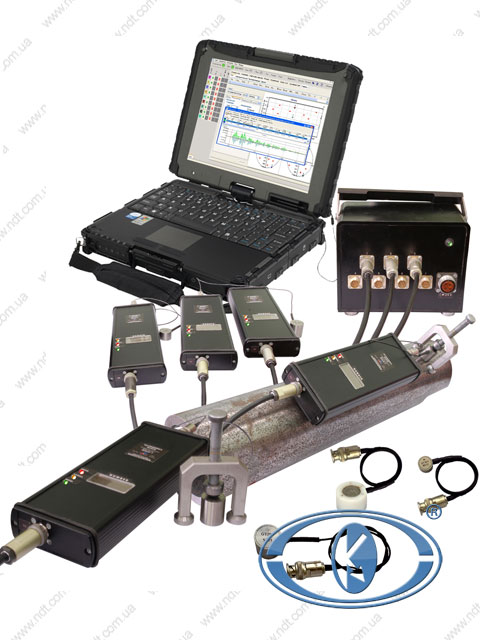
GALS-1 acoustic emission system for flaw detection
Image

Purpose

GALS-1 is intended for nondestructive testing and evaluation of technical state of critical objects without their decommissioning; for detection, position determination, hazard evaluation and monitoring of the sources of acoustic emission signals (defects) of testing objects – tanks and pressurized vessels, oil storage tanks, pipelines, hoisting devices, drilling platforms, bridges, nuclear and chemical reactors and other engineering and industrial structures and parts.

Application fields

GALS-1 can be applied for technical diagnostics of the following objects:

  • Pressure vessels
  • Containers and tanks
  • Main and field oil and gas pipelines
  • Industrial pipelines of industrial enterprises
  • Pipelines transition through obstacles
  • Hoisting devices
  • Objects of community facilities
  • Objects of railway transport
  • Objects of energy industry

Advantages of the AE technique

  • AE diagnostics using GALS-1 allows testing of the whole object integrally or even of several objects. At the same time, it enables detection of the most dangerous defects (disposed to development) and their classification by the risk level.
  • AE testing by means of GALS-1 does not require preparation of the testing object surface or delagging (except small areas where the probes will be placed); makes it possible to perform the testing of objects which are partially inaccessible (underground parts of pipelines, tanks, etc.).

Advantages of GALS-1 system

  • Flexible architecture allows optimal configuration of the system for the testing of various objects – lengthy, compact, groups of objects (see the figure below).
  • Usage of up-to-date element base and innovation circuit solutions enabled attenuation of input noise with AE probe connected to 2-3 µV.
  • Owing to the fact that signal digitization is carried out in the immediate vicinity of AE probe and also owing to the presence of high-quality digital and intelligent program filters in the channel, the highest noise immunity of system channels is assured.
  • All equipment – both separately and as a whole – is subject to the strictest acceptance inspection, including testing for the influence of the most severe climatic conditions, vibrations etc., what ensures high reliability of the system.

Examples of system configuration

Distinctive features of GALS-1

  • Number of channels of the system is chosen optimal for each testing object – with discreteness of 1 channel (within 100 channels). In the sequel, the purchased system can be extended by connecting additional channels and triggering units to it.
  • System self-testing warns an operator about failures (including cable breaking, fault of acoustic coupling of AEP with a testing object).
  • "Visual search of a channel" function allows quick orientation in the channels arrangement on a large object or a group of objects.
  • "Alteration of a channel number" function helps to correct errors quickly in the channels arrangement.
  • LEDs on the case of channel units permit to get immediately information on the state of each channel – its operationability, fact of signals arrival and approximate activity, existence of ADC overflow.
  • Powerful system of intelligent filters, including cutoff of pulse and repeatable interferences, cutoff by the signal shape etc., enables successive operation even under the conditions of considerable amount of interferences.
  • Intelligent oscilloscope-spectrograph permits to save oscillograms only for those signals which require this.
  • Advanced algorithms of location, the usage of such innovations, as "smart threshold", reverberation account, "multigroup cutoff" etc., make it possible to get a clear location picture instead of "stellar sky".

These and other features of the system, making its functionality, are described in detail in section "Description of GALS-1 main functions"


Channel display panel              Oscilloscope-spectrograph

Description of GALS-1 main functions

System self-testing

To assure the maximum reliability of testing with the aid of GALS-1, the self-testing function is included in the system software. Self-testing contains:

  1. Self-tests of the system equipment;
  2. Check for the sufficient available free memory on the system computer disk;
  3. Check of channels connection – tracking of integrity of information cables, operability of triggering  units and correctness of their switching.
  4. Check of probes connection – tracking of integrity of signal cables and their connection to channel units.
  5. Check of acoustic coupling – inspection of acoustic coupling quality between each EAP and testing object.

Self-testing can be performed both on operator's demand and automatically with periodicity specified by an operator.

Location

Software of GALS-1 enables to perform zone, linear, planar, cylindrical, spherical locations on the objects:

  1. linear – pipelines, metalware elements, etc.;
  2. plane – deck, large beams, flat areas of large parts, etc.;
  3. pipe – pipelines, tubular members of metalwares, etc. ;
  4. cylindrical tank – oil and gas storage tanks, other large containers with cylindrical rings;
  5. cylindrical vessel / tank – pressurized cylinders, tank car boilers, vessels, etc.;
  6. spherical vessel – vessels and tanks of spherical form.

Location is carried out basing on the analysis of time difference of signals arrivals from one event to different channels of location group. At the same time, the signal arrival time can be measured by the threshold crossing, by the maximum amplitude reaching or by "smart threshold" – taking into account the signal shape.

To make location more precise, reverberation should be taken into account, and to make the amplitude of the signal initially generated by the event more precise – attenuation.

Mode of multigroup cutoff allows optimal usage of location features of each group, avoiding replication or omission of events from sources, disposing close to the responsibility areas boundaries of adjacent location groups.

Hazard evaluation


Display and visualization of II-class source detection

During location (in real time and in post-processing) GALS-1 software automatically searches for the sources of AE activity – clusters of AE events – and classifies their threat by the criterion chosen by an operator:

  1. three types of amplitude criterion;
  2. integral criterion;
  3. local-dynamic criterion;
  4. cluster criterion.

The criteria are taken in accordance with DSTU 42227-2003, PB 03-593-03 and other regulatory documents, and the ones of own elaboration.

Filtering of flows of signals and events

GALS-1 software is able to filter AE signals and events by their parameters both in real time and in post-processing. It is possible to set filters in the form of a logic combination of inequations, such as "Parameter value is in the specified range of values". Besides, one-dimensional and two-dimensional graphics filters can also be created on diagrams, charts and location picture. Therefore, in the overwhelming majority of cases it is possible to cut off an interference having discovered its differences from AE desired signals and formed an appropriate combination of filters.

Intelligent filters of interferences cutoff

To assure AE testing even under the conditions of high noise level, GALS-1 software provides for a variety of intelligent filters, namely:

  • Filter of pulse interference – helps of cut off random bursts of thermal noise and thereby, operate at lower level of threshold.
  • Filter of clutter – deletes the signals generated by electric pick-ups.
  • Filter of shape factor – lets through only the signals which shape corresponds to the shape typical for the signals from AE events.
  • Filter of location cutoff – cuts off the signals arrived from outside the testing area, and also many interfering signals.
  • Filter of repeatable interference – enables to cut off the interferences generated by machinery operation, the power interference of 50 Hz, etc.
  • Filter of amplitude-energy cutoff – cuts off deliberately wrong-formed packets of signals.

AE data visualization

To see raw data from the wanted perspective often means to solve the task. That's why, in GALS-1 software much consideration is given to diverse types of AE data visualization both in the course of its acquisition and in post-processing. The program creates several hundreds types of diagrams and charts by the parameters of signals, events and parameters of loading. Here are possible types of graphical materials:

  • Time dependences.
  • Probability distributions.
  • Cumulative diagrams.
  • Diagrams of interdependence of signals and events parameters.
  • Channel-by-channel dependences.
  • Oscilloscope and spectrograph.
  • Load parameter dependences.

To work with these graphical materials, the whole set of tools is provided for:

  • Clustering
  • Addition of graphic background (e.g., photograph or drawing of the object under the location picture)
  • Application of linear and logarithmic scales independently by every axis
  • Graphic filtering
  • Measurement by means of measuring cursors
  • Color coding of a chosen parameter
  • Manual and automatic scaling

Software interface

Taking into account a considerable experience of the company in the production of intelligent NDT tools, much attention was paid to elaboration, friendliness and usability of the program interface during GALS-1 software development.

Buttons of quick access to the software main function connected, first of all, with the control of information acquisition and visualization are situated on the toolbar. Moreover, there are also indicators permitting to estimate immediately the system state as well as the current testing results:

  • “System status” indicator shows if the system is ready for operation (if the self-testing result is positive), and also if the signals are arriving (if there is AE activity).
  • “Disk” indicator indicates if there is enough available memory on the system computer disk.
  • “Class” indicator shows the maximum class of hazard among all detected sources of AE activity.
  • “Loading” indicator indicates the stage of loading process, warns an operator when the loading approaches potential dangerous values.

Control panel of the system channels is situated in the left part of the screen. For each connected channel there is:

  • Button of channel inclusion / exclusion from the data acquisition process.
  • Button of switching on / off of oscillograms acquisition via this channel.
  • Button of actuation of the pulser-simulator built in the channel.
  • Indicator of current activity of AE signals received by the given channel.
  •  Indicator of amplitude of signals received by the channel at the moment.

Program work space has a tabbed structure, i.e. all opened windows can be distributed practically at any number of tabbed pages. As a result, one can easily work with a considerable quantity of windows, displaying diagrams and charts, even on the computer with a small screen. As a rule, subject sets of tabs are made. For example: "Acquisition – Main", "Oscilloscope", "Acquisition – Add. Diagrams", "Analysis – Location", "Analysis – Time dependences", "Analysis – Filtering" and so on.

Using a set of profiles created beforehand (a list of tabs, windows, their arrengement and settings), an operator can switch promptly between a set of visualization and analysis tools, aimed at solving different tasks.

User manual

Enclosed illustrated operation manual, performed in a modern friendly style, contains detailed instructions on the system setup, access and usage of all functions of GALS-1 software.

Reports generation

GALS-1 software provides for the master of reports generation. It is possible to form and save a necessary number of report forms (including a composition and arrangement of texts, tables and graphic primitives). Afterwards, a report is generated automatically – all an operator has to do is to indicate a file with report form and a file with data which should be used for report forming. Reports can be printed out, stored or exported to Microsoft Office applications.

Specifications

General data

Number of channels from 1 to 100 with discreteness of 1 channel

Types of triggering  units (TU)

7-channel and 15-channel
Length of cable segment between TU and a cable

up to 100 m
Registration of all signals parameters by channel up to 1000 signals/s

Registration of all signals parameters by system

up to 15700 signals/s

Electric power supply of the system ~220 V (187 ÷ 242 В) 50±1 Hz

Reception path

Gain coefficient (with a step of 1 dB)

15 ÷ 68 dB

Input noise level in a band of 20 ÷ 800 kHz no more than 5 µV

Input noise level in a band of 30 ÷ 500 kHz no more than 3,5 µV
Range of operating frequencies 10 ÷ 800 kHz
Amplitude-frequency characteristic unevenness in the frequency range from 20 to 800 kHz ±1,5 dB

Dynamic range

no less than 95 dB

Sampling frequency of ADC

2,5 МHz

ADC capacity

16 bit

Digital oscilloscope

Number of channels by 1 in each channel of the system

Sampling frequency

2,5 МHz

Number of points of one oscillogram

up to 163000

Pre-triggering up to 200 µs

Number of pre-triggering points to 500

Built-in pulser-simulator

Quantity by 1 in each channel of the system

Type of generated signal packet of square pulses (meander section)

Pulse amplitude

4, 8, 16, 32 V

Pulse duration

250 ÷ 2500 ns

Number of pulses in a packet

1 ÷ 10

Packet repetition frequency 0,3 ÷ 40 Hz

Measured AE parameters

List


Time of signal arrival  

Time for reaching the max. amplitude


Signal duration


Max. signal amplitude (in ADC points and in dB)


Signal drive


MARSE (area under envelope)


Counting (number of overswings – threshold crossings)


Average frequency of signal spectrum


Min. frequency of signal spectrum


Max. frequency of signal spectrum


Noise level before a signal


Some quantitative adjectives


Max. amplitude up to 108 dB
Dynamic range of amplitude measurement no less than 95 dB

Dynamic range of power measurement

no less than 175 dB

Range of signal counting measurement

1 ÷ 52000

Range of signal duration measurement

1 ÷ 65000 µs
Error of signal amplitude measurement no more than ±1 dB

Error of signal arrival time difference measurement no more than ±0,5 µs
Additional parameters


Overflow flag by amplitude (off-scale reading of ADC)


Flag of max. duration exceeding


Flag of saved oscillogram availability


Flag of signal usage in location  

Programmable parameters

Range of noise cutoff level (threshold) setup

0 ÷ 108 dB

Range of max. signal duration setup

1 ÷ 65000 µs
Range of setup of single channel event time out (SCETO)

0 ÷ 1000 µs
Range of setup of rise time time out (RTTO)

0 ÷ 1000 µs
Range of dead time setup 0 ÷ 65000 µs
Range of setup of noise level measurement time 100 ÷ 2000 µs
Range of setup of bass and treble frequencies of the main filter 0 ÷ 1250 kHz

Parametric channels

Quantity 4 channels per unit of parametric channels
Input types

by current and / or by voltage
Input by voltage (built-in voltage source +24 V)

4 ÷ 20 mA

Input by voltage 0 ÷ 10 V

ADC capacity

12 bit

ADC frequency

50 Hz
Passband

0 ÷ 10 Hz

Measurement error ± 2,5 %

Operation conditions of measuring and parametric channels and triggering units

Ambient temperature

–20 °С ÷ +50 °С

Relative humidity at the temperature of +25 °С no more than 95 %

Level sealing protection from penetration of water and solid bodies (according to GOST 14254)

IP65


On top
Home | About Us | Partners | Feedback
 
All Rights Reserved © “OKO Association” 2008 - 2010
All rights for articles, illustrations and other materials are the property of rightholder
and protected by the law of Ukraine “About Intellectual property rights and associated rights”.
While the material using, reference to website is obligatory.